Kendra Wright
Founder & CMO, Rebel Media Agency


This time of year, I sit down with every firm we work with and write their marketing plan for the next 12 months.
It's not 40 pages or a slide deck nobody opens after it's built. The marketing plan is a short, organized doc we come back to all year when we make decisions and check in on our progress.
Why write it down? For years, I kept each firm's strategy in my head. We still did great work, but our clients couldn't see the full roadmap. They weren't always sure what we were doing or where their marketing was headed.
A written marketing plan fixes that. It shows the firm where we're putting our time and energy this year, and the results we expect that work to create.
Every plan we write follows the same order. Here's each section, why it's there, and a real (anonymized) example so you can see what it looks like.
What are we trying to accomplish together?
I've been surprised by how many firms don't have growth goals everyone agrees on, or a shared way to measure them. So every plan starts here, before we talk about channels or tactics.
I ask every firm two questions:
Having both makes the plan more flexible. If the firm hits their baseline goal, we still have a stretch goal to aim for.
I'll gut check both numbers against where the firm's marketing is today. If the numbers are unreasonable, I'll tell the firm.
This helps us establish what revenue we want to drive with marketing for the year.
These are 3 to 5 results we want marketing to drive, and each one gets a number. Revenue is one, but we often aim for a few more key objectives too. For each key objective, I'll quantify it.
We won't just say, "Get reviews." Instead, we would have a goal of "Get 50 reviews." It's okay if we don't hit every number, but we'll at least be aligned and aiming at the same thing.
A few examples from real plans:
👉 Notice what's not on this list: "post 3 times a week" or "launch a podcast." Those are activities. Objectives are the results you want those activities to create.
These are the numbers we track all year, so leadership and marketing are looking at the same scoreboard:
Before we add anything new, we write down what's working so we can build on it. This part also shows a firm what I see when I look across all of their marketing at once.
A few examples:
👉 Cutting things belongs on this list too. Sometimes the biggest win of the year is what you stopped doing.
Who are we trying to reach with your marketing?
This section is short on purpose. It's one paragraph that keeps everyone (leadership, your team, your marketing partner) aligned on exactly who we're marketing to. Your deeper ideal client research lives somewhere else.
Here's what it looks like in a real plan:
Many of the firms we work with serve several types of clients: retirees, business owners, tech executives. Their website may speak to all of them. But we usually only market to one or two.
That's because you can only market to one client type per funnel. If one YouTube channel talks to retirees on Monday and business owners on Thursday, the platform doesn't know who to show your videos to. Your viewers get confused too.
Where are we going to reach them?
This is where most advisors want to start. "Should we be on YouTube? LinkedIn? Do we need a podcast?" I get it. But the right channel depends on your goals and who you're trying to reach, which is why it comes third.
A channel is simply where people find you: Google search, YouTube, LinkedIn, a podcast. Most of our firms build one or two core channels alongside client referrals.
For example:
👉 You don't need to be everywhere. Each channel can be its own standalone funnel.
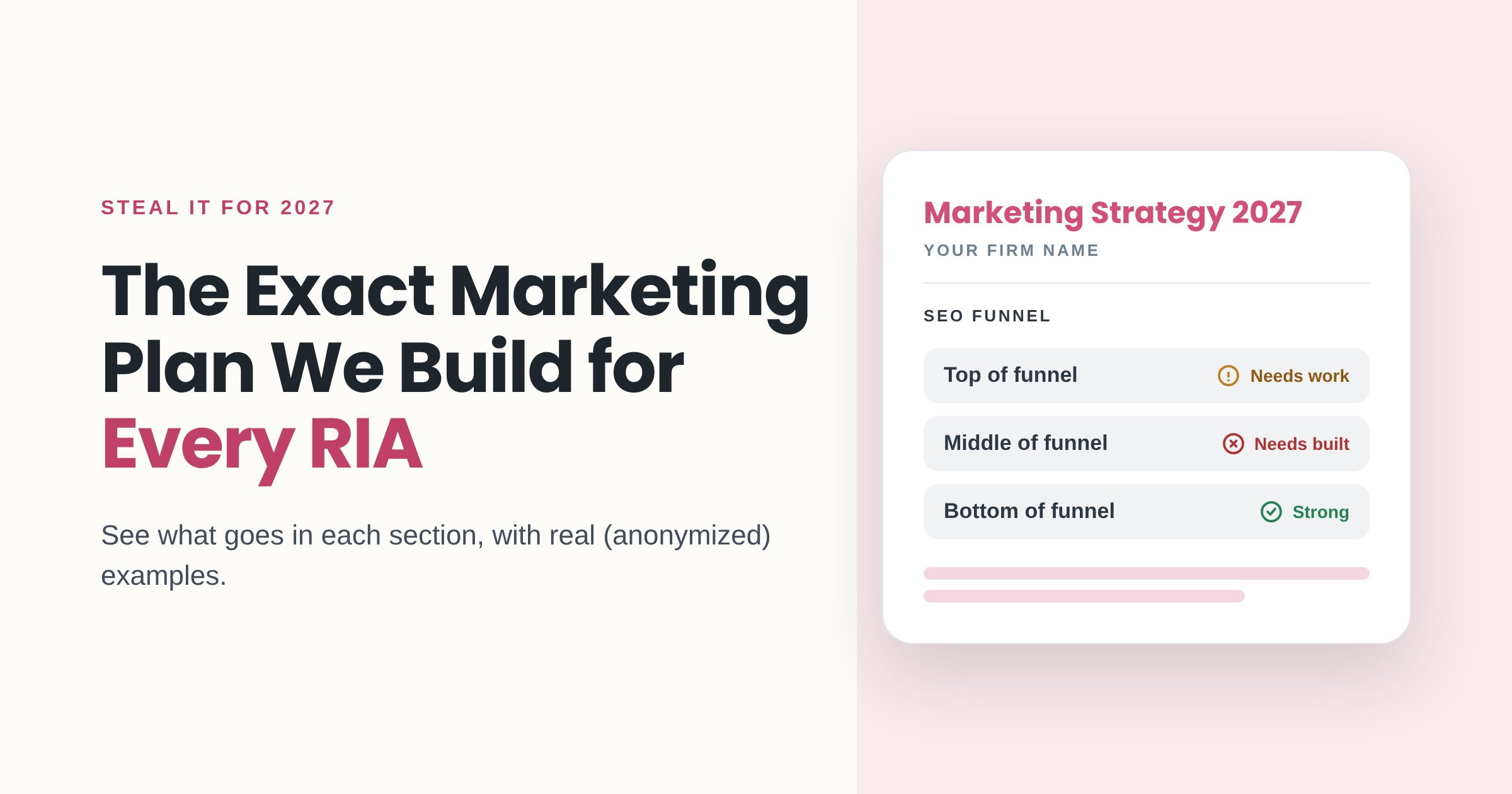
Saying "we're doing YouTube" isn't a strategy yet. Every channel has a funnel behind it, with three layers:
Then we grade each layer: ✅ strong, ⚠️ needs work, ❌ needs to be built.
| YOUTUBE FUNNEL | STATUS | DETAILS |
|---|---|---|
| Top of funnel | ✅ Strong | Long-form videos targeted at pre-retirees |
| Middle of funnel | ⚠️ Needs work | Long-form videos targeted at pre-retirees |
| Bottom of funnel | ✅ Strong | Sales process to convert new clients |
This is where funnels get interesting: On YouTube, one activity (publishing long-form videos) covers more than one layer. Other channels work differently. A podcast has no algorithm to put you in front of new people, so the top of the funnel has to come from somewhere else:
| PODCAST FUNNEL | STATUS | DETAILS |
|---|---|---|
| Top of funnel | ⚠️ Needs work | Guest appearances on other shows your ideal client listens to |
| Middle of funnel | ✅ Strong | Your own podcast with weekly episodes |
| Bottom of funnel | ✅ Strong | Sales process to convert new clients |
Grading the funnel tells you where to look when a channel isn't bringing in clients:
Then you fix that one spot instead of starting over on a new channel.
One caveat: people aren't robots. They don't move through these layers in a neat line, and they bounce around. We're just building a thoughtful path from "I found you" to "I trust you" to "maybe I'll hire you." And only a small slice of your audience will ever take that last step.
What has to be in place no matter which channel someone finds you on?
Your marketing channels help you get visibility and build trust.
Your foundation is the key items we need to build for your advisory firm, no matter what channels you choose. Some of them support your strategy (ideal client documentation), others are seen by prospects directly (key pages on the website, reviews).
We keep a running foundations list and add to it as I learn what makes the biggest difference for advisors. Then, we score it for every firm.
Here's a preview of the kinds of items we include in foundational marketing assets:
| ITEM | STATUS | WHAT "STRONG" LOOKS LIKE |
|---|---|---|
| Ideal client documentation | ✅ Strong | A profitable ideal client is defined and written down |
| Website: homepage | ✅ Strong | Clear, compelling copy and design |
| Website: About page | ⚠️ Needs work | Clear, compelling copy and design |
| Website: call booking | ✅ Strong | Easy for the right people to book a call |
| Client reviews | ❌ Needs built | An ongoing process to keep collecting reviews |
| Lead magnet | ⚠️ Needs work | A free resource built for your ideal client that people actually sign up for |
If your funnel is working but your website isn't, you can lose people right before they book a call. This view shows us which pieces to strengthen first.
What are we building this year?
These are the biggest projects we'll work toward this year. Each one either strengthens a funnel or fills a gap in the foundation, and we tag it with what it supports.
A few real projects from our plans:
A full plan usually lists 10 to 12 projects. We add them to Asana as top priorities and pick 1 to 3 big ones each quarter, alongside the regular content we publish.
We usually finish about 70% of the list in a year. Other priorities always pop up, and that's fine. The list keeps us pointed at the work that will make the biggest difference.
What are we saying "not now" to?
This section is one of the most unique parts of our plans. The biggest threat to most marketing plans is a pile of good ideas and no agreement on which ones to set aside.
This list protects the plan from shiny objects and from doing too much at once. A few real non-goals from our plans:
I draft this section with my recommendations, then review it with the firm's leadership and get their sign-off.
For example, one firm kept asking me about adding channels, even though we had plenty of lead flow available on the channels we had already chosen. For that year, "no new channels" became an official non-goal.
👉 "Not now" doesn't mean "never." It means we've agreed to wait, so we don't re-debate it every month.
What could get in our way this year?
Before the year starts, we ask: if something gets in our way this year, what's it likely to be? We name those problems up front, honestly and kindly, so we have a plan before they show up.
A few real threats from our plans, and what each one puts at risk:
When a threat is named early, it's much easier to talk about when it shows up. Nobody's caught off guard, and nobody feels blamed.
Want to see how all seven sections fit together? Here's a full sample plan for a made-up firm.
Pre-retirees in the Austin area, 3 to 7 years from retirement, with at least $1M saved. They've done a great job saving but don't know how to turn their savings into a paycheck that lasts.
The firm also serves business owners and tech executives. They'll stay on the website, but they aren't a target of our marketing this year.
| SEO FUNNEL | STATUS | DETAILS |
|---|---|---|
| Top | ⚠️ Needs work | Articles written for Austin pre-retirees |
| Middle | ❌ Needs built | Free retirement income guide |
| Bottom | ✅ Strong | Intro call and sales process |
Articles bring in traffic, but publishing slowed this summer. There's no free guide yet, so readers who aren't ready to book a call have nowhere to go. That's the biggest gap to close.
| REFERRAL FUNNEL | STATUS | DETAILS |
|---|---|---|
| Top | ✅ Strong | Happy current clients |
| Middle | ⚠️ Needs work | Client newsletter and referral emails |
| Bottom | ✅ Strong | Sales process for referrals |
Clients are happy, but many don't know the firm is taking new clients. Two referral emails a year will make the ask clear.
| YOUTUBE FUNNEL | STATUS | DETAILS |
|---|---|---|
| Top | ✅ Strong | Long-form videos for pre-retirees |
| Middle | ⚠️ Needs work | Long-form videos for pre-retirees |
| Bottom | ✅ Strong | Intro call and sales process |
Average views are climbing, and our click-through rate is strong. Our next core step is improving scripting and viewer retention to strengthen the middle of the funnel.
| ITEM | STATUS | NOTES |
|---|---|---|
| Growth goals | ✅ Strong | Clear targets for new clients and revenue |
| Ideal client | ✅ Strong | Defined and written down |
| Homepage | ✅ Strong | Speaks directly to pre-retirees |
| About page | ⚠️ Needs work | Reads like a resume; doesn't connect to pre-retirees |
| Call booking | ⚠️ Needs work | Too many steps before someone can pick a time |
| Client reviews | ❌ Needs built | No ongoing process to ask for reviews |
| Lead magnet | ❌ Needs built | No free resource for people not ready to talk yet |
Whether you work with a marketing partner or do it yourself, here's what to steal from our approach:
Keep the whole thing short enough that you'll actually open it every month when you review your marketing progress and metrics.
Want more advisor marketing content like this?
👉 Join our newsletter: Attention to Assets
We break down real advisor marketing, share what's working (and what's not), and show you how to apply it to your own firm.