Kendra Wright
Founder & CMO, Rebel Media Agency


Welcome to Behind the Funnel—where we break down real advisor growth stories and reverse-engineer what made their marketing funnel work.
Jesse Cramer runs a retirement-focused podcast. In 2025, it generated 53 inbound prospects, 9 new clients, and $130,000 in new annual recurring revenue.
But this isn't just a story about podcasting—it’s a case study in building an effective marketing funnel.
Whether you podcast or not, there's a lot advisors can learn from Jesse's evolution and how he has improved his marketing approach over time.
In this edition of Behind the Funnel, we’re breaking down:
Before We Start:
Jesse is not a client of my business, Rebel Media Agency, and no compensation was provided in exchange for this case study. This funnel breakdown was built from a 90-minute conversation I had with him about his podcast funnel.
He was also a guest on my podcast, Advisor Marketing Made Simple (How to Grow a Podcast That’s Already Converting). This breakdown builds upon that conversation.
The results shared in this case study are specific to Jesse’s situation and are not necessarily indicative of typical results for other advisors. This content is for informational and educational purposes only and does not constitute financial or investment advice.
All stats below are cumulative for the year 2025.
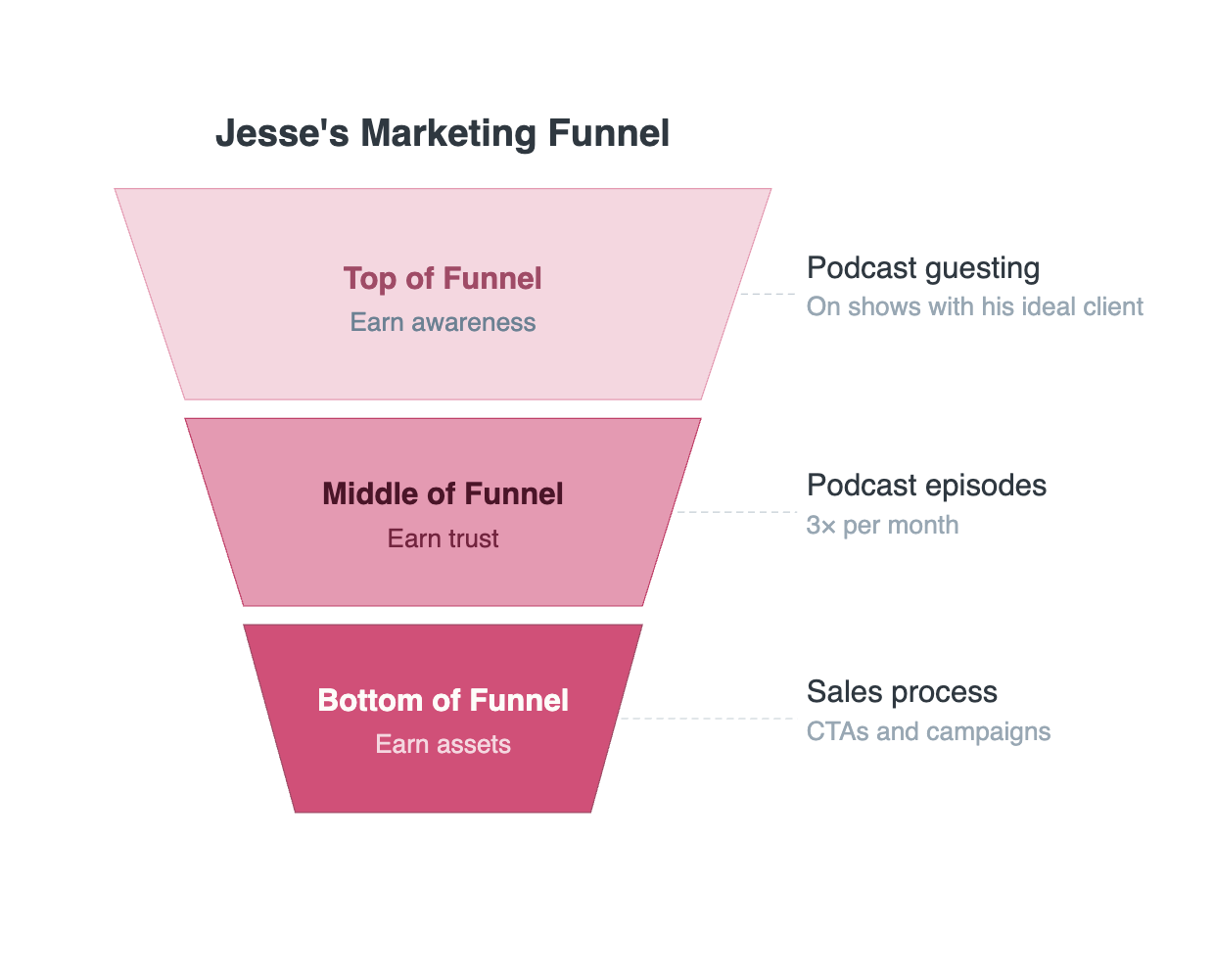
Here is Jesse’s funnel that we’ll breakdown today:
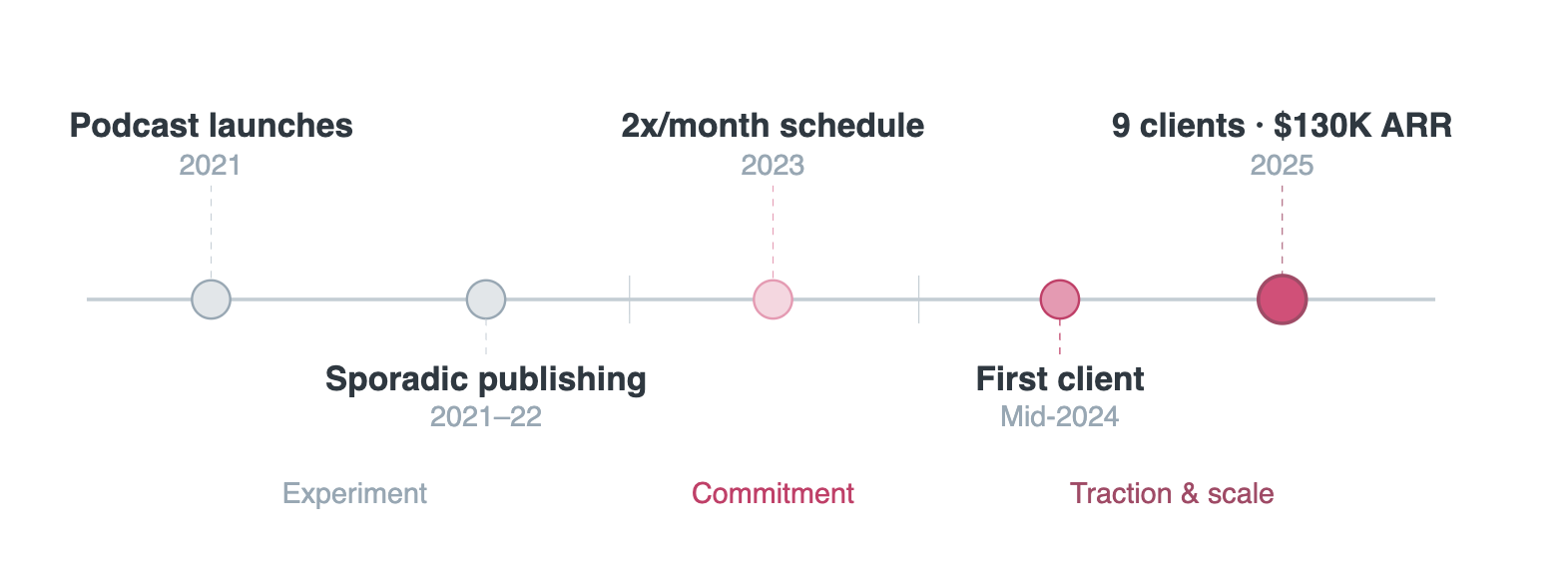
When Jesse Cramer launched his podcast in 2021, he wasn't doing it to build a lead generation machine. He liked the idea of hosting a show and he wanted to see what would happen.
For the first couple of years, it was mostly that: an experiment. Something that felt useful but wasn't yet producing paying clients.
Then in 2023, something shifted. Jesse committed to a real publishing schedule—two episodes a month, for a full year. No excuses.
Sixteen months later, his first legitimate client reached out. A total stranger! Someone who had found the podcast on their own and decided Jesse was the advisor they wanted to work with.
That moment changed everything. Jesse realized that he could reach real people looking for wealth management advice and he went all in.
In 2025, Jesse's podcast, Personal Finance for Long-Term Investors, generated over 120,000 downloads, drove nearly all of his inbound leads, and produced $130,000 in new client revenue—off a $11,000 marketing budget spend.
His funnel is scrappy, converting, and growing in its ability to drive paying wealth management clients.
Today, we break his entire working funnel down and identify new ways to improve its performance.
In the early days of the podcast (2021-2022), Jesse was publishing episodes, but not consistently.
#1 - Episodes went out when he had time. The content was high-quality and educational. But there was no real schedule or commitment to cadence.
#2 - His ideal client type was fragmented. When he joined our podcast Advisor Marketing Made Simple for live coaching on how to improve his funnel, he described his ideal client as three different kinds of people.
#3 - There was also no clear bottom of the funnel. Jesse rarely made it clear that he was a professional financial advisor accepting new clients.
He was building an audience without building a funnel. People were listening. Some of them probably would have hired him. But there was no clear path from "I love this podcast" to "let me work with Jesse."
"There was no bottom of the funnel. It just wasn't there." — Jesse Cramer
OVERVIEW OF CHANGES TO THE FUNNEL
In 2023, Jesse made a decision that would change the trajectory of the podcast: he committed to a real publishing schedule.
Two episodes a month for a year straight. No exceptions.
This sounds simple, but consistency was the foundation all of his funnel changes built upon.
But the publishing commitment was just the start. Jesse also made a few other meaningful changes. We will break each of these down by layer of the funnel.
In 2025, Jesse joined us on the Advisor Marketing Made Simple podcast. We told him to go more narrow on his ideal client to build a more effective funnel.
Listen Now: How to Grow A Podcast That Is Already Converting With Jesse Cramer
While most of his content was retirement focused, there were some topics that were not targeted enough and those needed to go.
His biggest demographic (men 45 to 61) wasn't there by accident. They were there because retirement-adjacent content is what resonated. Although he was nervous to go more narrow, he stopped hedging and fully leaned in. The podcast became, in his words, a retirement podcast. Full stop.
Here’s what Jesse had to say about his hesitance on creating a retirement focused show:
“I know two-thirds of the industry is retirement focused, but guess what? That's where 90% of the potential clients are probably coming from." - Jesse Cramer
➡️ What All Advisors Can Learn: What most advisors miss is that even though many in our industry target the same demographic, very few market to them effectively.
Many firms will have content across different client types (retirees, equity comp, HENRYs) and multiple channels. This is why most advisor marketing fails to drive results.
Let me share with you another funnel I’ve helped fix with this EXACT same problem (ideal client confusion in the funnel and talking to multiple client types).
Here’s an example of what marketing to this niche often looks like when it’s ineffective from old YouTube videos on Thomas Cook’s channel:
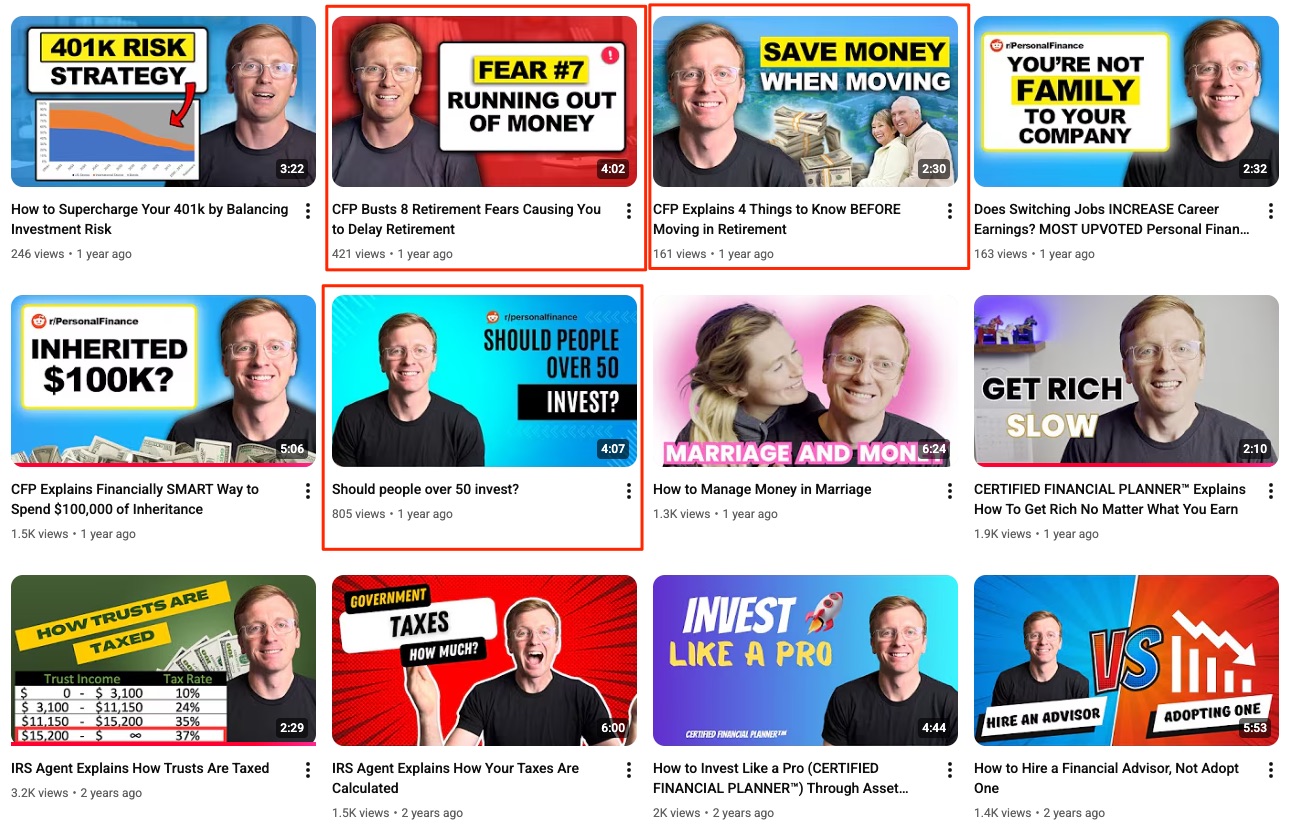
Of 12 videos, only 3 spoke to the retirement niche.
Thomas claimed that pre-retirees were one of his (multiple) ideal client types. Yet he was driving zero clients from YouTube (even though he was incredible on camera!)
His average video was getting 200-2,000 views.
Why? His content wasn’t TARGETED enough to retirees.
After coaching on our podcast, we told him to double down on retirees. Cut all the personal finance videos and broad topics. Retirees should see themselves in every piece of content he ships.
And the outcome? Totally nutty.
This is how targeting retirees looks when it’s razor sharp:
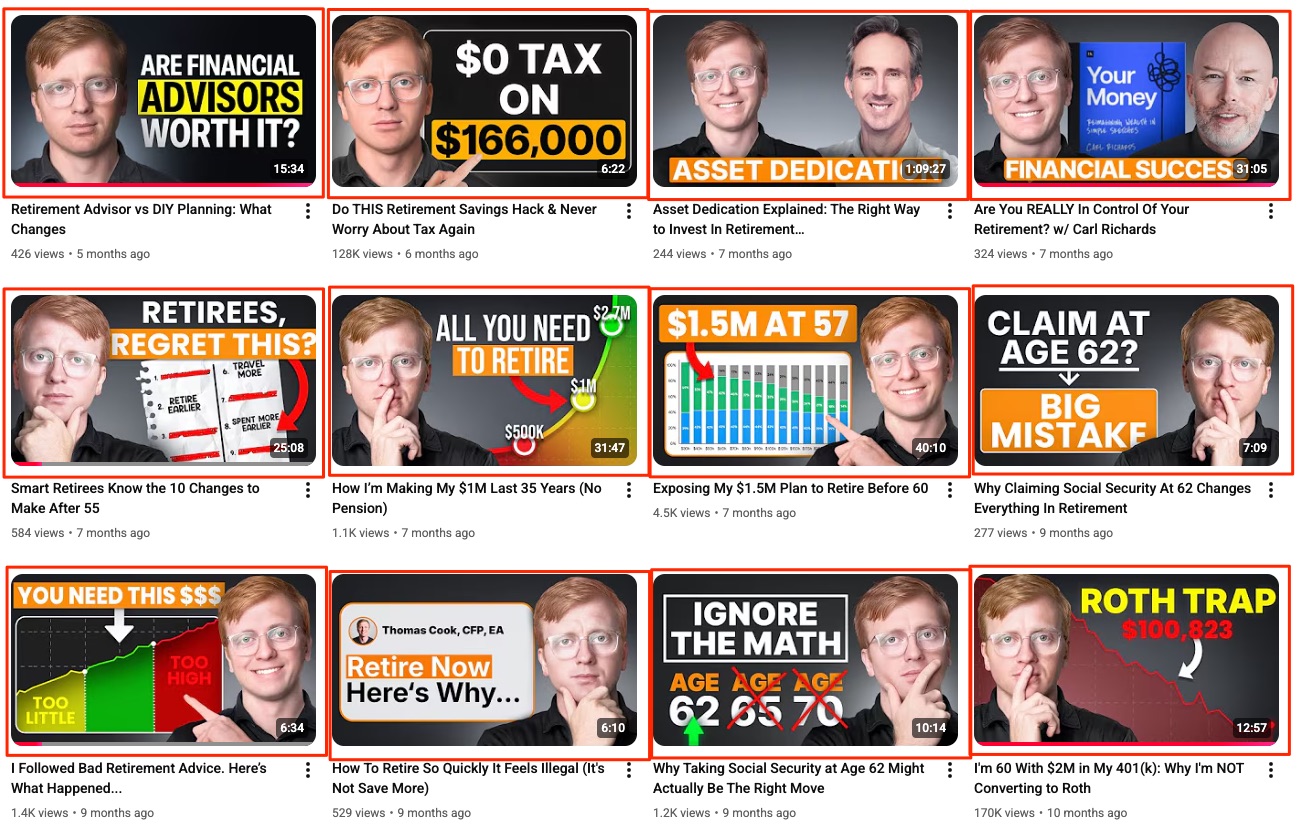
The last time I spoke to Thomas at XYPN in Austin, I asked him how his marketing was going. He said, “Oh my gosh Kendra. I’m swamped! I have so many leads I had to stop posting videos because my calendar is booked.”
This is what true marketing to retirees looks like in your funnel.
Ask Yourself: When you look at your content is it radically clear who it’s trying to reach?
Want to market to multiple client types? You’ll need to build multiple funnels.
For most advisors, that’s more than they can reasonably handle. When I work with larger firms that want to build multiple funnels we assign one advisor per funnel.
Remember: One ideal client per funnel. This is what pulling your ideal client through your funnel looks like and it can create remarkable results when you dial each layer of the funnel in.
Based on our recommendation on Advisor Marketing Made Simple, Jesse developed a strategy for getting onto other podcasts more frequently that his ideal client (retirees) would listen to.
Without a strategy to get on other shows, your podcast will struggle to grow. Why?
Unlike many other platforms, podcasts have no algorithm.
On LinkedIn, Instagram, or YouTube, the platform actively puts your content in front of people who've never heard of you. The algorithm is doing top-of-funnel work for you and helping you reach new people.
Podcasting doesn't work that way.
As of now (early 2026), there is no feed, no discovery engine, no mechanism that places your show in front of new listeners who have never heard of you before.
If you just publish and wait, you're essentially invisible to anyone outside your existing audience. This means that as a podcaster, you have to be your own algorithm.
And the most effective way (by a wide margin) to do that is to go on other podcasts.
The logic is simple: people who listen to podcasts already listen to podcasts. They're already in the habit. They already have their apps open. Getting in front of them through a show they already trust is dramatically more effective than trying to convert someone who consumes content in a completely different format.
Turning a YouTube viewer or a LinkedIn scroller into a podcast subscriber is difficult. Turning someone who already listens to podcasts into a listener of your podcast is much easier because you're meeting them exactly where they already are.
Why Repurposing Podcast Content Isn’t A Good Use Of Time: I've tested repurposing podcasts via short clips to social media and YouTube with clients for years. It's expensive, time-consuming, and the conversion rates are disappointing. My strong recommendation is to put almost none of your growth energy there.
Jesse understood this and started building a real system around the #1 way to grow podcasts effectively: guesting on other shows.
Jesse’s Systematic Approach To Podcast Guesting
He began by building a list of target podcasts and organizing them into four tiers:
He started his outreach with Tier 1—locking in the easy wins first, building confidence and momentum—and then worked his way into the harder tiers. His goal for 2026 is approximately two dozen guest appearances, up from one or two per quarter in prior years.
He's also batching the outreach to other podcasts. He blocks off a few hours to create thoughtful, personalized email outreach to each host.
➡️ What All Advisors Can Learn: You want to reach people who are already in the habit of listening to audio. Stay in the medium. Don't try to drag people across formats. Find the listeners who are already out there and give them a reason to find you.
This principle applies to other platforms too (social media, YouTube, etc.) Don’t try to coax people to change platforms to follow you. You’ll need a top of funnel strategy to drive awareness on the channel you are on.
Improving a funnel layer by layer is the core reason I recommend channel focus.
If you're juggling too many channels, you will not have the time to do the work to improve each layer of your funnel. Getting on other podcasts is challenging, and it takes a lot of work to do it well.
When Jesse committed to a real schedule in 2023, he started with two episodes a month. That was the baseline. Consistent, sustainable, and frankly, the minimum viable commitment for a podcast that wanted to be taken seriously.
But Jesse didn't stop there. He ran a poll through his newsletter asking listeners directly: do you want more episodes? Do you want them longer or shorter? The answers were clear.
More, please. And shorter episodes—or at least, not longer.
He took the feedback seriously. By the time we sat down for this conversation, he was publishing three times a month.
This matters because frequency is one of the few direct levers a podcaster has over download growth.
More episodes mean more entry points for listeners and more touchpoints with your existing audience every month.
For a channel with no algorithm doing the discovery work for you, every additional episode is another chance to connect with your listeners.
➡️ What All Advisors Can Learn: Each platform has its own needs for consistency. Often advisors are not publishing consistently enough, even in algorithm-driven platforms, to get the visibility they'll need to build a working funnel.
Here is how consistency could change across different platforms:
Each platform is a bit different, so you have to understand what the needs are there.
Every episode now includes a short, consistent mention that he works at a wealth management firm, helps clients nationwide, and that listeners can learn more or start a conversation at his website.
He’s also started testing more direct promotions during high-intent windows. A Q4 campaign he ran in late 2024 prompted seven to eight direct outreaches in a short window. Three of them became clients!
These changes weren’t complicated. But they were the difference between a podcast people enjoyed and a podcast that produced real revenue.
➡️ What All Advisors Can Learn: Many advisors don’t want to be pushy. They pour endless energy into content but struggle to ask their audience to hire them.
Becoming comfortable with compelling calls to action is a skill you can (and must) build. You need to create a path from content to your calendar or you’ll struggle to drive paying clients from your efforts.
The way you make your calls to action can differ across platforms but it has to be a part of your process in a consistent and frequent way.
Tell people that you are a financial advisor or CERTIFIED FINANCIAL PLANNER® (not a financial influencer) that is accepting new clients.
And, you’ll need to do it more often than feels comfortable!
Taylor Schulte shared on Advisor Marketing Made Simple how he learned that he had to draw it in crayon for his audience too:
“I learned really quickly that listeners didn't even know I was a financial advisor. They didn't know that I was taking on new clients. They didn't know who I worked with and how I could help them. That I was a CFP® and had clients. A lot of listeners just thought I was a financial influencer just doing a podcast.
It wasn't until I actually drew this stuff in crayon and went to my audience was like, "Here's who I am, here's who I specialize in helping, and if that's you and you're interested, go here to take action” — and the phones just started lighting up." - Taylor Schulte
Hear More: 5 Marketing Improvements To 3x Revenue In Three Years (AMMS)
If someone has consumed a considerable amount of your content and trusts you deeply, they still need a clear, repeated invitation to start a conversation with you. Without it, they'll wait. And waiting often means they hire someone else or no one at all.
The middle of the funnel content builds trust but bottom of funnel calls to action convert it.
You need all the pieces working together. Don’t forget to make consistent and clear calls to action on a consistent basis.
Jesse's podcast funnel is already working well. But I identified a handful of clear optimization opportunities to make it work even better.
Here's everything I'd tackle, organized by funnel stage.
Jesse already rebranded once from The Best Interest to Personal Finance for Long-Term Investors around episode 100. The intent was searchability around the topic of personal finance.
The problem is that the new name is accurate but doesn't signal "retirement podcast" to someone browsing Apple Podcasts or Spotify.
The way you title and optimize your marketing assets should help you attract the right people and repel the wrong people.
When I searched for top retirement podcasts, Jesse's show did come up in AI overviews and search results—even without the word retirement in the title. This is good. But to signal to potential listeners what the show is about more effectively I would do two things.
That's a gap Jesse could fill in a unique way.
It’s also a great reminder for other advisors that we work in pixels online. Changing a title or adjusting a prior marketing decision isn’t hard to do as you improve your marketing efforts.
Here’s my Google search for “Top Retirement Podcasts” and what the overviews deliver:
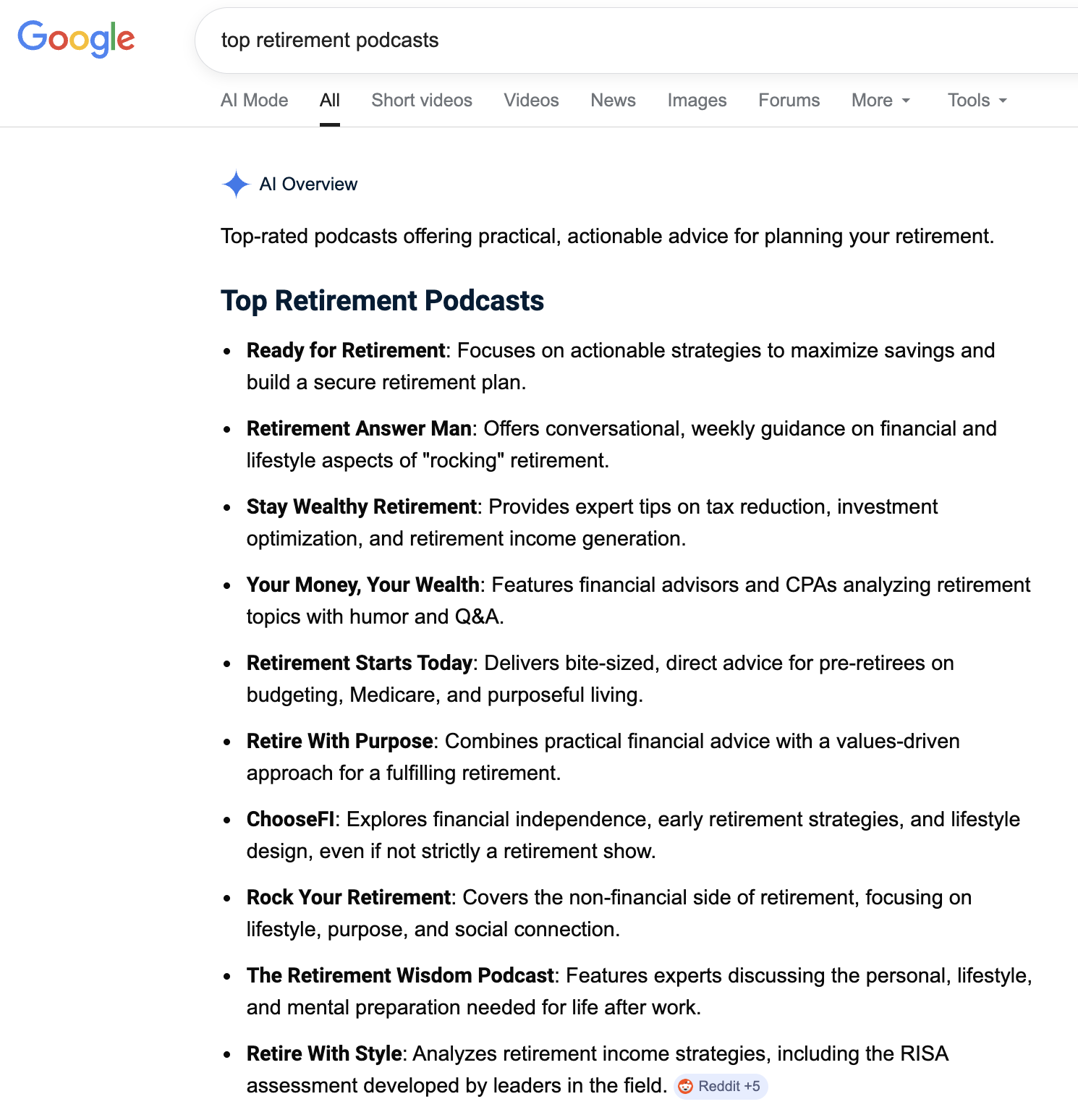
I wouldn’t just add the word retirement, I’d try to choose an option that stands out.
Here are a few titles I'd explore:
These would be easy to promote on other shows and memorable for new listeners.
If he wanted to adjust what he already has without a full title change it could look like this:
The goal isn't just SEO–although the keyword in the show title is nice.
It's niche clarity and memorability—especially for the top-of-funnel work Jesse is doing by guesting on other shows. When you're a guest, you want to be able to say your podcast name once and have it stick.
His current show title feels long and too broad:
Personal Finance for Long-Term Investors - The Best Interest
You want the branding and packaging of your content to communicate WHO it’s for and WHAT it’s about.
When someone scrolls a podcast feed or looks up your podcast, album art does a lot of work. High-contrast, visually bold covers catch attention.
Jesse's current art is clean, but a brighter, more distinctive color treatment would help him stand out in a crowded category.
For Jesse, he could use inspiration from a top marketer in another industry (Alex Hormozi) and use a bright blue as a background that would be close-ish to his current branding.

If he rebrands the podcast, I’d give the album art another facelift in the process.
Jesse's current voiceover intro runs about ~20 seconds. I'd cut it to ~10 seconds. Listeners push play to hear the content and your perspective. Getting to the content faster is a better experience and allows you to build trust faster.
On our podcast, Advisor Marketing Made Simple, our time from start to content was 8 seconds. This was an intentional design. We cut every word to the bone to get straight into content.
This is a small change but it’s a good item to tighten once and move on.
The URL Jesse currently directs people to book a call with him is long and hard to remember when someone is driving, working out, or doing dishes.
His current URL: bestinterest.blog/work
Buying a simple vanity URL—something like callwithjesse.com—and forwarding it to his booking page solves this completely. It's inexpensive, fast to set up, and removes a real friction point between a motivated listener and a scheduled call.
You can often forward these inside the same place you buy the vanity URL or have a web developer forward it for you.
Right now, Jesse's intro CTA runs well over a minute before the actual content begins. The CTA is important—but it should be brief, punchy, and easy to act on. Something like:
"I am a financial advisor to retirees ready to stop working. I help clients nationwide who have diligently saved and are ready to retire. If you'd like my help, click the link at the top of the show description or visit callwithjesse.com to schedule a call with me."
That's it. 15 seconds. Everything essential, nothing extra. Jump straight to content after that CTA.
I’d also draft 3-6 different punchy CTAs like this so you can do a different one for each episode and not create a predictable CTA. Switch it up to keep listeners engaged.
This is the highest-leverage change on the list, and it costs the least.
Right now, many of Jesse's episode titles are broad and could be improved to earn more clicks so that people press play when they see the episode in the newsfeed.
We want the titles to speak directly to a fear, a question, or a counterintuitive idea.
Here are examples of current episode titles and how I’d rewrite them:
A few other packaging rules I'd apply across the board:
In my experience working with podcast clients, improving episode packaging can increase downloads by roughly 25%—with the same content, the same production effort, and the same publishing schedule.
Even after episodes go live, you can easily update their titles, and they will update in podcast feeds.
Beyond the titles, there's an opportunity to sharpen the ideation process itself. A few sources I'd add to Jesse's rotation:
The goal isn't to copy what everyone else is doing, it's to find fresh ideas and counterintuitive angles so your content catches attention in the feed.
Jesse's “Ask Me Anything” episodes are often almost an hour long.
Splitting them into two or three separate, tightly focused episodes could add another 10% to download numbers because:
This one tiny shift could get his publishing cadence up to a weekly frequency without increasing his production time or effort.
Jesse maintains a blog alongside his podcast. What may be surprising to other advisors is this:
The website does ~15,000-20,000 visits per month but the podcast is driving 97% of the leads.
Here’s my take on why: While he does have great website traffic, converting website visitors to clients is a separate funnel than a podcast funnel. He has a few key pieces but it’s likely half built.
Because the website isn’t driving new client growth, I would pause posting any new blogs and reinvest that time into better podcast episode ideation and title writing.
This shift in effort would almost certainly produce a bigger return than continued blogging.
Most podcast listeners are on their phones. The show description is right there, one tap away. Putting a clean, direct CTA at the very top—"Ready to explore hiring Jesse? Click here."—with a clickable link removes the step of having to remember a URL and navigate to it later.
Jesse can easily mention it in his calls to action on the show along with his vanity URL.
Jesse's Q4 2024 campaign proved the concept: a focused, timely push anchored to a real reason to act now can produce a disproportionate number of new client conversations in a short window.
I'd put these on the calendar as intentional campaigns—not just occasional ad reads. Two or three dedicated episodes in a row, with a specific, time-anchored reason to book:
I've found capitalizing on high-intent periods when people are looking for advisors can work well for advisors with platforms built (like podcasts, email lists, etc).
Jesse has reached a stage I call the crossover point: he's generating enough leads and a good chunk of them are unqualified. That's a good problem! Once you're there, the next best move is to add more friction to your call booking process.
You can use a tool like Jotform or Typeform to create a form that has some simple logic and asks people to enter their income or assets to prequalify. If they are not qualified, instead of sending them to your calendar, you redirect them to a thank you page with other resources.
This allows you to protect your calendar from unqualified calls.
Using a form with logic has helped filter out hundreds of unqualified calls for our own clients at Rebel Media Agency, and it's an absolute game changer when your lead flow gets higher.
Jesse's funnel still has a lot of room to grow, and I think his lead flow will pick up even further as he makes refinements.
If you're not there yet, keep your booking process open. When you get there, add the friction with qualifiers.
Jesse's funnel runs through a podcast. Yours might run through LinkedIn, YouTube, SEO, or something else entirely. But the principles behind what he built apply everywhere:
👉 Join our newsletter: Attention to Assets
We break down real advisor funnels, share what's working (and what’s not), and how to apply it to your advisory firm.